
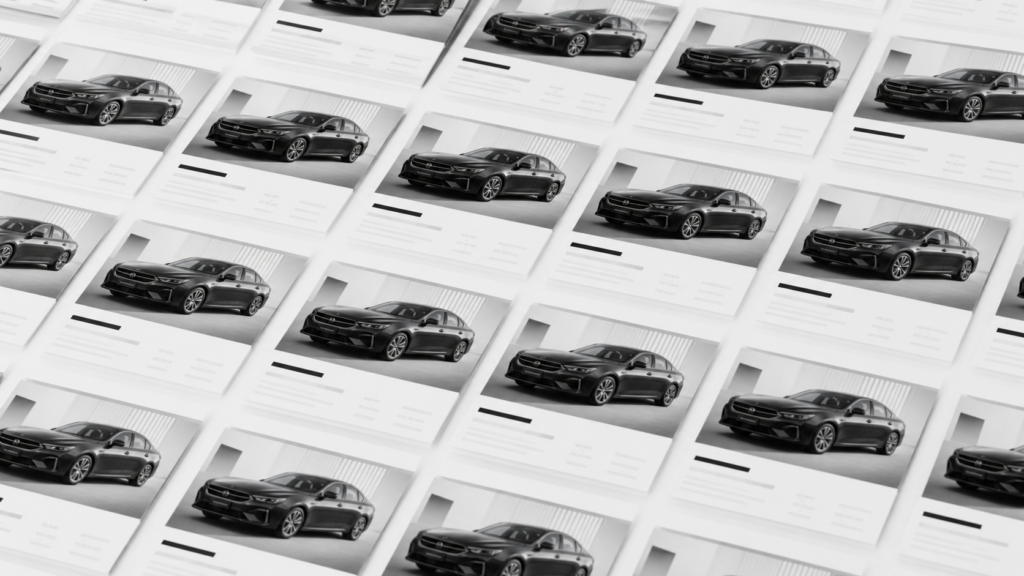
Your dealership website probably has a duplicate content problem, and you have no idea it exists. It does not throw an error. It does not show up in a monthly report. It just quietly holds your rankings down while you wonder why the traffic never comes. For most dealers, the culprit is the same thing that fills your site with fresh listings every day: the inventory feed.
Why Inventory Feeds Create Duplicate Content
The same vehicles that sit on your lot sit on dozens of other sites too. Your feed provider pushes identical VIN descriptions, factory blurbs, and boilerplate specs to your site and to every other dealer running the same platform. Two hundred dealers can end up with the exact same paragraph describing a 2023 model. When Google sees the same block of text in a thousand places, it has to pick one to show and ignore the rest.
It gets worse inside your own site. Filtered search pages, sort orders, and session parameters spin up dozens of URLs that all show nearly the same inventory. A single used truck can live at five different addresses on your domain. Google crawls all of them and sees repetition where you meant to show organization.
Picture a shopper filtering your used lot by price, then by mileage, then by color. Each click can generate a new URL, and each one shows a nearly identical slice of your inventory. Multiply that across every vehicle and every filter, and a store with two hundred cars can quietly present thousands of near-duplicate pages to Google, none of them clearly the one that should rank.

How Duplicate Content Actually Hurts You
Search engines do not hand out a formal penalty for most duplicate content. The damage is quieter than that. When the same content appears in many places, Google has to choose which version to rank, and it often does not choose yours. Your crawl budget gets burned on near-identical pages instead of your best content. Ranking signals that should point to one strong page get split across five weak ones.
The end result is that a page you spent money to build never earns the position it deserves. You are competing against copies of yourself and against every other dealer running the same feed.
Crawl budget is the part dealers overlook. Google only spends so much time on your site each visit. If it burns that time crawling forty filtered versions of the same used sedan, it may never get around to the model landing page you actually want ranking. You are effectively hiding your best work behind a wall of duplicates.
Canonical Tags: Your First Line of Defense
The canonical tag tells Google which version of a page is the real one. When five URLs show the same used sedan, a canonical tag on each of them points back to the single page you want to rank. This consolidates the ranking signals instead of splitting them.
- Self-referencing canonicals on every primary vehicle and category page so the preferred URL is never ambiguous.
- Parameter handling so filtered and sorted URLs point back to the clean version instead of competing with it.
- Consistent internal links that always send visitors and crawlers to the canonical address, not a tracked variant.
A quick way to check whether this is set up correctly: open a filtered inventory URL, view the page source, and look for the canonical tag. If it points back at that same messy filtered address instead of the clean category page, your canonicals are working against you. On many vendor sites they are missing or misconfigured, which is exactly the kind of thing you cannot fix when you do not control the code.

Rewrite the Text the Feed Gives You
Canonical tags fix the plumbing, but they do not solve the bigger issue: your descriptions read like everyone else’s because they are everyone else’s. The fix is original text. Add a few real sentences to your high-value category and model pages that describe the vehicle in your own words, for your own market. A paragraph about how a certain SUV handles local winters gives Google something no feed can copy.
You do not need to rewrite every VIN. Focus on the pages that can actually earn rankings: model landing pages, body-style categories, and your best-selling used inventory groups.
Think about what your salespeople say on the lot that the factory blurb never will. Which trim is right for a long snowy commute, why a particular pickup fits the local trades, how a model holds its value in your market. Put a few of those true, specific sentences on the page and you have content no feed provider can hand to a competitor, because it came from your store and your customers.

Own the Fix, Not Just the Symptom
Duplicate content is a structural problem, and structural problems need an owner. When a vendor manages your site as a black box, you cannot see which pages are canonicalized, which text is unique, or where your crawl budget is going. When you own the structure, you can prove the fix worked in rankings and in cars sold.
Frequently asked questions
Does Google penalize my dealership for duplicate content?
Not with a formal penalty in most cases. The harm is quieter: Google has to pick one version to rank and often does not pick yours, while your crawl budget and ranking signals get split across near-identical pages. The result feels like a penalty even though it is really just lost visibility.
Do I have to rewrite every vehicle description?
No, and you should not try. Focus your original writing on the pages that can actually rank: model landing pages, body-style categories, and your best-selling used groups. A few true, market-specific sentences on those high-value pages does far more than lightly reworded text spread across every VIN.
How do I know if canonical tags are set up right?
Open a filtered or sorted inventory URL, view the page source, and find the canonical tag. It should point to the clean, preferred version of the page, not back at the messy variant. If it is missing or pointing at itself on a filtered URL, that is a problem to fix, and on a locked vendor platform it may be one you cannot reach.
This is the kind of result you should own, not rent from a vendor. See how VCTRS builds dealer-owned SEO on our car dealership SEO page.